
How we build
Built around your workflow. Not the other way round.
Between one and three weeks from the first call to handover. This is not a product you configure or a seat you rent. The system is designed around your workflow, it runs for you alone, and you operate it.
Every system is built for one client. Not sold to many.
This is not a subscription, and not a product you configure. There is no shared platform, no seat licence and no template. We build the system around your workflow, your inputs, your output formats and your channels, then hand it over. An agency, a solo founder and a hundred person company each get a different build, because the requirements are different.
-
7 to 21 days
Typical build time, first call to handover, depending on scope.
-
From $2,000
Where a build starts. Cost moves with scope, and there is no package tier to pick.
- Privacy protection
- Data security
- Built to the AI Act rules in force
- Lower running cost
- Runs 24/7
- No monthly subscription
- No headcount
- No HR
- No payroll
- No sick leave
- No employment law
You monitor it. The system does the work.
What you are buying
Not a generator. A production standard.
The reason a build takes days rather than minutes is that the output has to hold up as work, not as output. AI covers the writing. The craft is held to the bar an editor and an animation artist would hold it to — which is what took right-first-time from 60% to 98.5% on the account we measured.
- Writes and researches the script
- Generates the voiceover
- Writes descriptions, keywords and hashtags
- Reviews every asset before it is queued
These uses are disclosed at the point of generation and recorded on every asset, because that is what the rules in force require.
-
Edited, not generated
Intros, outros, music, transitions and pacing, cut the way an editor cuts them.
-
Typography and motion
Kinetic type, lower thirds and motion graphics built against your design system.
-
Animation with a hand in it
Drawn-style animation, letterforms and shapes, the way an animation artist would tablet them.
-
Told as a story
Structured to hold attention and carry authority, not assembled to fill a slot.
-
Yours, not a template
Every run is composed against your brand. No two clients receive the same treatment.
-
Graphics finished by hand
Thumbnails and posts composed piece by piece, not poured into a preset.
One system standing in for a video editor and an animation artist, at the same standard, in less time and at lower cost.
The build
From your workflow to a system that runs it.
We do not start from a template. We map how your content gets made today, agree what the system should run on its own and what stays with your team, build it to the machines and platforms you already use, then stay responsible for it once it is live.
-
Requirements analysis
We go through how your content gets made now and mark what is slow, what breaks, and what is worth fixing first. You leave knowing whether a system is worth building for you.
-
Workflow design
We agree what the system runs on its own, what runs with a person in the loop, and what stays manual, then the same again for review. Every input and every output is named, and the whole path is joined up end to end.
-
Pipeline build
Built to run where you want it: in the cloud, entirely on your own machines, or a mix of both. A dedicated host or a local machine for anything that has to run around the clock, on macOS, Windows or whatever your team already uses.
-
Protection and rights
Sensitive material is encrypted and kept inside the system, credentials are stored properly, and nothing is passed to anyone beyond the one AI vendor the build runs on. Video is produced to editor standard rather than generated, so the build stays inside the AI Act and copyright rules with you.
Read the rights and AI Act position in full -
Test run
We run the whole thing as a demo, from the first upload through to the finished output, and tune it until it is right. Nothing is deployed until you have watched a full run and approved it.
-
Deploy and support
You get the system and do your work through its front end. The code behind it stays with us, the way a studio keeps its working files, which is how we can stand behind the build and fix anything that breaks. When you want the pipeline changed later, you tell us and we make the change with you.
Who owns what, and what it costs
Scope moves the length. A single channel with one format sits near the short end; a multi-brand build with approval gates and several destinations sits at the long end.
A real build
A system we built, in use today.
This is the front end of a system we designed and built for a client, in use today. Their document names, file paths and channel names are blurred out. Everything else is exactly what their team sees.
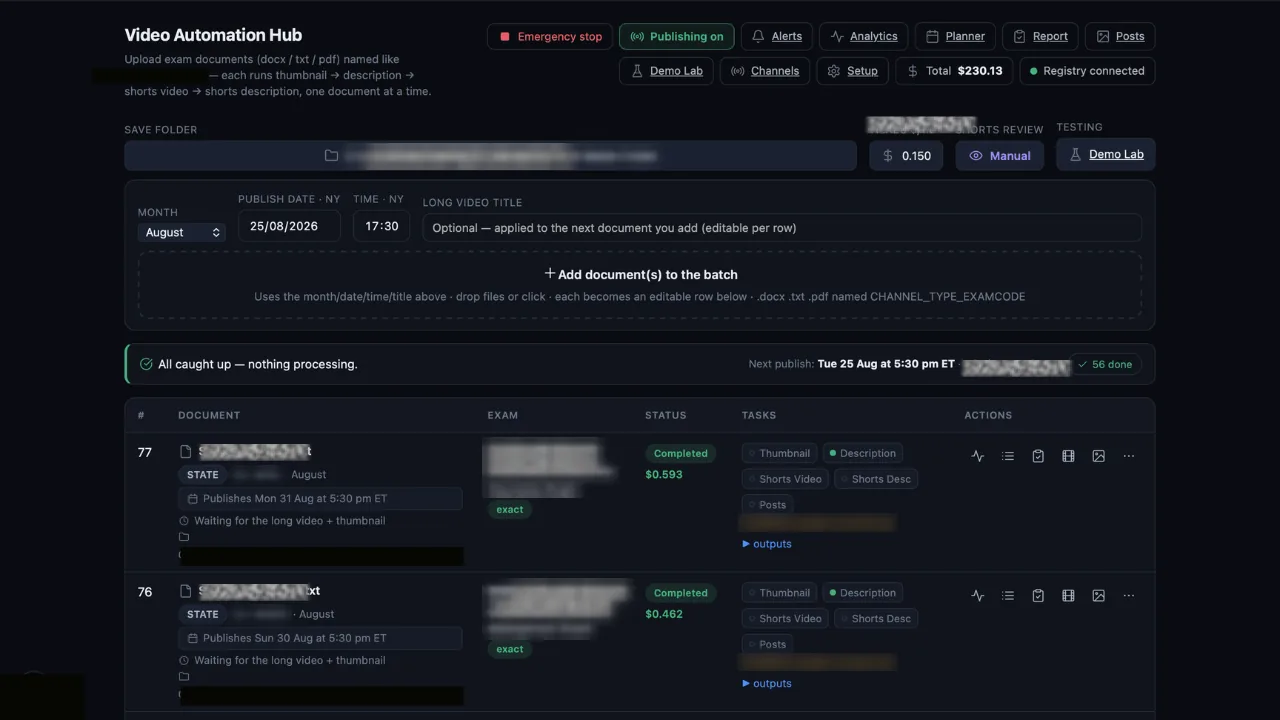
Where the work goes in
The operator adds documents, sets the date and time they should go live, and leaves. Each row shows what stage that piece is at, which files are finished, and what the run cost to produce.
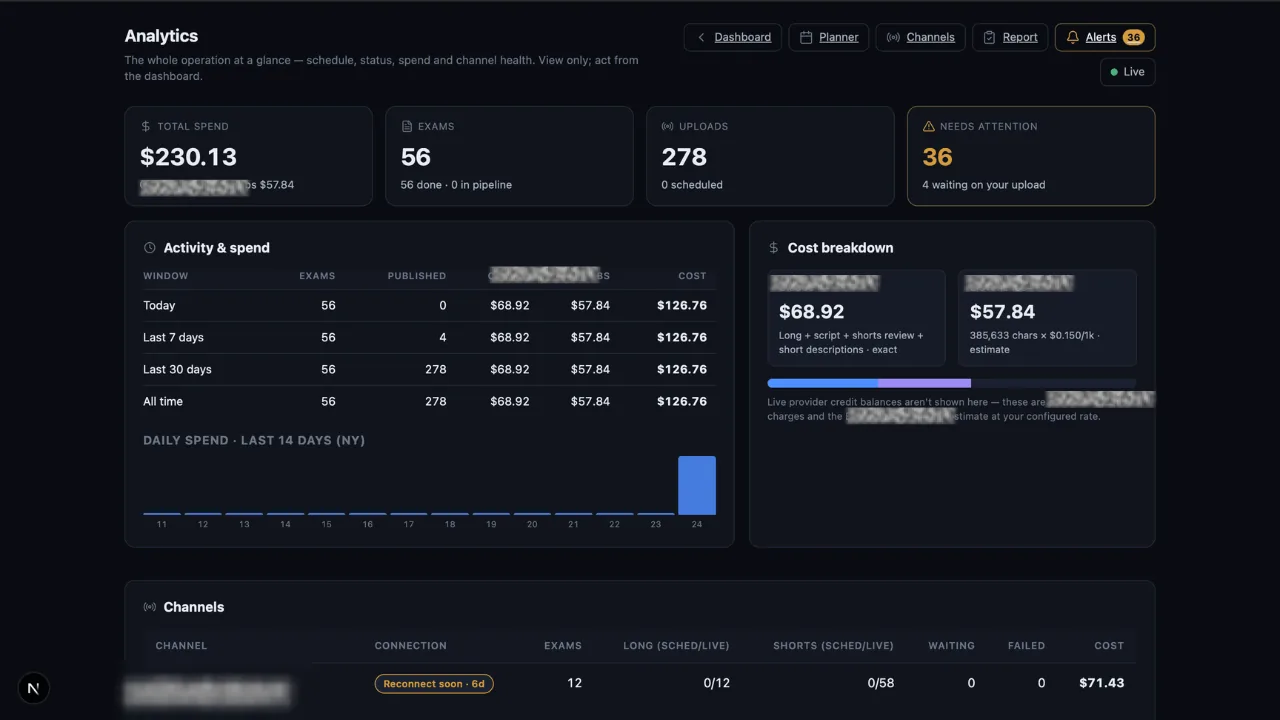
The whole operation on one screen
Schedule, status, spend and channel health in one view. Anything needing a person is raised rather than left to be found, down to a channel whose connection is about to expire.
Built for one client, around their workflow. Not a template they filled in, and not a seat on a platform shared with anyone else.
After handover
What happens once it goes live.
The build has a finish line. The support does not. The code behind it stays with us, and this is what that is for.
-
Tested before it launches
We run the whole thing end to end on our own demo channels and social accounts, several times over rather than once. A system only reaches your channels after it has already published to ours, which is why most of what we launch never produces a bug in production.
-
Watched after it launches
A monitoring agent checks the system continuously and repairs most faults on its own, without anyone being called. On top of that we monitor every new system by hand, daily, for the first thirty days.
-
When a platform pushes back
Instagram and TikTok occasionally reject a post or flag it as spam, usually when a description carries too many links. Every link, hashtag and description is checked before a piece is queued, and we publish through the official platform APIs rather than around them.
Your part
What we need from your side.
We do the building. These are the things only you can hand over, and the decisions only you can make. Gather them before the first call and the build starts the same week.
-
Your brand
- Colours, fonts and logo files
- Your website, and the links you want carried
- Videos and graphics you have run before, or references you want matched
The first stage of the build is trained on these. It is why the output looks like you and not like a template.
-
Where it runs
- Local machine or cloud. We recommend local.
- The machine and its specification: a Windows PC, or which Mac
- A UPS and a steady connection, so a power cut cannot stop a run mid-production
-
Who runs it
- Who monitors the system day to day
- Who else needs access to it
- Which of them need a login of their own
-
How much, and where
- How many pieces you publish in a month
- Which platforms you need covered
Option 01Recommended
You give us access
We connect every account and configure the whole thing. Faster, and when setup is done you reset your own passwords, so our access ends there.
Option 02
You set it up yourself
Your team makes each connection and we walk you through it, one platform at a time. Nothing leaves your side.
No accounts yet? That is fine. If you are starting from scratch we create the channels and set them up for you, profile and cover artwork designed with them. There is nothing you need to build before the build starts.
At least three meetings. One to agree the requirements, one to watch the system demo, one to sign off the changes that came out of it.
Book the first oneBefore the build call
What people ask before they commit.
How long does it take to build a custom AI content system?
Seven to twenty one days from the first call to handover, depending on scope. A single channel with one format sits at the short end; a multi-brand build with approval gates and several destinations sits at the long end. It needs at least three meetings from you: one to agree the requirements, one to watch the system demo, and one to sign off the changes that came out of the demo.
What do we need to provide before the build starts?
Your brand colours, fonts, logo files and website, plus any videos or graphics you have run before or want the output matched to. The first stage of the build is trained on those, which is what makes the output look like you rather than like a template. We also need four decisions: who monitors the system, who else needs access and their own login, where it runs, and how many pieces a month across which platforms.
Do you need access to our social media accounts?
The system publishes to your accounts, so those connections have to be made once. You have two options. Either you give us access and we connect and configure everything, which is faster, and once setup is finished you reset your own passwords so our access ends there. Or your own team sets each connection up and we walk you through it, in which case nothing leaves your side at all. Either way the accounts stay yours.
Does the system run on our own machines or in the cloud?
Either, or a mix. We recommend local. Tell us the machine and its specification, a Windows PC or which Mac, and we build around it. Anything that has to run around the clock wants a UPS and a stable connection, so a power cut or a dropout does not stop a run halfway through production. If you would rather it ran in the cloud, it can.
What happens if the system breaks after it goes live?
A monitoring agent watches the system continuously and repairs most faults on its own, without anyone being called. On top of that we monitor every new system by hand, daily, for the first thirty days. Support is 24/7 by ticket from day one and stays that way. The full run is tested end to end on our own demo channels several times before it touches yours, which is why most of what we launch never produces a bug in production. Bug fixes are covered by the guarantee. Changes and updates are quoted separately.
Why do Instagram and TikTok reject posts, and how do you stop it happening?
The usual cause is a description carrying too many website links, which the platforms read as spam. The system checks every link, hashtag and description before a piece is queued, and no asset reaches a channel without its copy having been reviewed first. Publishing runs through the official Meta, YouTube, X and platform APIs rather than around them, so a post is confirmed as accepted rather than assumed.
Do we get the source code with the system?
The system is yours. It runs where you chose to put it, on your accounts and your data, and your team works through its front end. The code behind it stays with us, the way a studio keeps its working files rather than handing over the project source. That is what lets us guarantee the build, fix anything that breaks and keep improving it for you. And if we ever stopped trading, every credential you need to keep the system running is handed straight to you.
How much does a custom AI content system cost?
It is scoped, not priced from a tier. Cost follows what has to be built: how many channels, how many brand profiles, how many runs a month, how much approval workflow, and how deep the integrations go. There is no package to pick and no per seat licence. Builds start at $2,000 and move with scope from there. Once it is live you pay the platform and AI usage for the runs you actually make, which starts around $100 a month and rises with volume; you can hold those accounts yourself or have us run them. There is no monthly fee to us for the system itself. We scope the rest on the call rather than quoting a range that would be right for exactly one buyer.
Tell us what your team does by hand.
Bring your current workflow to the call. We will tell you what a system for it would cover, roughly how long it would take, and whether it is worth building at your volume.
Book a build call